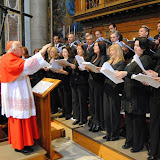
A Research Interview with Domenico Cardinal Bartolucci from June 2013 - Conducted by Wilfrid Jones, Student reading music at New College, Oxford [excerpts from NLM]:
W. J.: Could you talk about the music at Papal liturgies in St Peter’s Basilica before the Second Vatican Council?
D. B.: Before the Council, music had a fundamental role in the liturgical celebrations, and above all in the ceremonies where the Pope presided. The Sistine Choir performed the great repertoire of Gregorian chant and polyphony, handed down through the ages, with the masses of Palestrina at the center (of the repertoire). The place of music in the ancient liturgy was very great, and our role was not to amuse the faithful, but a true liturgical ministry. We were often accused of wanting to do concerts during the celebrations, but I do not believe that those who share this position have understood the role of sacred music in the liturgy.
W. J.: What impact did the Council and the Constitution Sacrosanctum Consilium have on music at Papal liturgies?
D. B.: In reality, neither the Council nor the Constitution on the liturgy had any practical effect on sacred music. If the ideas of the Fathers and of Sacrosanctum Conciliumhad really been followed, the results would have been very different, and very much in line with the tradition. In reality, I would say that all of the changes that were produced, and which in my judgment are negative, were determined by the work of application of the documents of the Council. This was done by a commission (theConsilium ad exsequendam Constitutionem de sacra Liturgia) which was not up to its role, and on which there worked people who wanted to impose their own ideas, distancing themselves from the official ideas of the documents. The way in which this commission worked has been analyzed in a very accurate study by Nicola Giampietro, O.F.M. Cap., based on the diaries of Cardinal Ferdinando Antonelli, which analyzed the developments of the liturgical reform from 1948 to 1970. This scholarly contribution has put a lot of light on the commissions actions, on the poor formation of its members, and the lack of professionalism with which they went about dismantling the liturgical patrimony which the Church had always jealously guarded in its liturgical life. As the cardinal observed in his personal notes: “liturgical law, which until the Council was sacred, for many no longer exists. Everyone considers himself authorized to do what he likes, and many of the young do exactly that. […] On the Consilium there are few bishops who have any particular competence in liturgy, very few who are real theologians. The most acute deficiency in the whole Consilium is that of the theologians. […] We are in the reign of confusion. I regret this, because the consequences will be sad.”
W. J.: During the Council, was there any pressure to modify the Papal liturgies?
D. B.: No, I would not say that during the Council’s work, there was any pressure to modify the Papal liturgies. Certainly, it would have been fine if certain aesthetic excesses had dropped out of use. This is part of the natural process of change that moves with the tastes and sensibilities of each era, but no one thought to change the liturgies, or banalize them, as was later imposed.
W. J.: Once the Council was finished, what impact did the implementation ofSacrosanctum Consilium have on Papal liturgies from 1964 to 1997?
D. B.: After the Council, and after the various experiments which unfortunately were permitted (as if the Church’s liturgy were something to experiment with, or make up on a drawing-board), a liturgy was produced which was substantially new. The consequences for sacred music were devastating. Sacrosanctum Concilium in paragraph 112 affirms that the musical tradition of the Church forms a patrimony of inestimable value, which exceeds all other expressions of art, especially because sacred music, united to the word, is a necessary and integral part of the solemn liturgy. Can you tell me where this “patrimony of inestimable value” is to be found today? The great polyphonic masses, the noble Gregorian chant: all put in the archives. Were these the intentions of the Council? Absolutely not. I myself had to struggle intensely to maintain something in the Papal liturgies, but with few results: an occasion motet, and every once in a while a gracious concession to do a Gloria in polyphony. I remember that one of the first requests made to me was to write music in Italian... Then, Monsignor (Virgilio) Noè (Papal master of ceremonies from 1970-1982) wanted the masses in alternating Gregorian chant, in place of those in polyphony. After a while, those were also gotten rid of, so that we could always sing the Missa de angelis in Gregorian chant, taking turns with a congregation which in reality was a group of nuns and priests… I was obliged to do this in my role as director of the Sistine Choir. I was able to save our great repertoire only in concert performances.