
April 10, 2013


February 25, 2013
January 28, 2013
Il fanone papale


January 14, 2013
December 26, 2012
Nativitas Domini A. D. 2012 - Fanon
 |
| Nativitas Domini A.D. 2012 - Fanon |
April 12, 2012
April 11, 2012
Ceremony of Papal Inauguration of Pope Benedict XVI [24.04.2005]
March 5, 2012
A Consistory between Tradition and Innovation
 Msgr. Guido Marini: Down the centuries the Consistory for the creation of Cardinals has developed a particularly rich ceremonial form. In previous centuries the creation of Cardinals took place in a secret Consistory at which the Pope would announce the new cardinals’ names. Straight after the Consistory the new cardinals resident in Rome would be notified of their nomination by means of the “biglietto” — which in 1879 prompted Bl. Cardinal Newman to give his famous discourse.
 That same day in the afternoon they would go to the Apostolic Palace to receive the red biretta from the Holy Father. Should a new cardinal who lived outside the city be unable to come to Rome, he would receive the biretta from the Pope through a special delegate. In such cases, he would have to promise to go to Rome within a year to receive his red hat and title in person from the Pope.
The subsequent Public Consistory would usually take place in St Peter’s Basilica but occasionally in the Sistine Chapel or in the Consistory Hall of the Apostolic Palace. Among the most moving moments in the ceremony would be the mention of the new cardinals’ act of obedience to the Pope, the imposition of the red hat (“galero”) and their prostration during the singing of the Te Deum, their heads completely covered by their hoods.
This was followed by the special rite of the aperitio oris (“opening of the mouth”), since, in the act of conferring the red biretta, the Holy Father had recommended to the new cardinals that they be shrewd and cautious in the use of words occlusio oris (“closing of the mouth”). The ceremony ended after the Pope had given a sapphire ring to each cardinal and assigned to him a titular church or deaconry.
After the Second Vatican Council the rites for the creation of new Cardinals, while preserving the essential elements, acquired a more modest, simplified form in comparison with the earlier rites. Indeed, although a distinction was no longer made between the public and secret Consistories, the oath, the imposition of the biretta (instead of the hat) and the designation of the title or deaconry were retained. However, the conferral of the cardinal’s ring took place at the Holy Mass that the Pope concelebrated with the new cardinals the day after the Consistory.
Paul VI used the revised text of the Rito (cf. Notitiae 5 [1969], 289-291) for the first time at the Consistory in June 1969. As Annibale Bugnini remarked, the wish to insert into a liturgical rite what in itself was not part of the liturgy was the guiding criterion for the elaboration of the new ritual. The intention was to give the Consistory a celebratory form but at the same time to avoid any element that might give the impression of a new ‘sacred order’ or a ‘sacrament of the cardinalate’ (La Riforma liturgica 1948-1975,CLV — Ed. Liturgiche, Rome 1983, p. 789, n. 15). Nevertheless the Consistory subsequently underwent further modifications which have brought it closer to being a true and proper Liturgy of the Word.
As Benedict XVI himself recalled, the Consistory “is an event that always inspires special emotion, not only in those who are admitted to the College of Cardinals with these rites but also throughout the Church, gladdened by this eloquent sign of Catholic unity. The ceremony's structure stresses the value of the task the new Cardinals are required to carry out in close cooperation with the Successor of Peter. It also invites the People of God to pray that in their service these Brothers of ours may remain ever faithful to Christ, if need be to the point of giving their lives, and that they may allow themselves to be guided by his Gospel” (Homily at the Ordinary Public Consistory, 24 November 2007).
In this regard and to emphasize the two aspects that must characterize the event — the new responsibility assumed by the cardinals and the context of prayer — after a few variations made in the practices of the most recent Consistories it was deemed appropriate to add a few small modifications which have recently been approved by the Holy Father.
First of all, since it is not a true and proper liturgical celebration the Holy Father wears choir dress (with a mozzetta and stole). Then at the beginning of the rite he pauses for a moment in silent prayer at the Confessio, above the tomb of St Peter.
For the two prayers at the beginning and end of the rite, the texts of 1969 that come from the great Roman euchological tradition have been used. These are texts of the Mass, on the occasion of the anniversary of the Bishop of Rome’s episcopal ordination, taken from the Veronense (the so-called “Sacramentarium Leonianum”). These orations speak explicitly of the powers entrusted to the Church, especially the power entrusted to Peter. Whereas in the initial prayer the Pope also prays directly for himself, as a successor of the Apostle, to carry out his office well, in the conclusive prayer the Pope invokes God’s blessings on the new cardinals.
The proclamation of the Word of God resumes the shorter form, like the rite of 1969, with the single Gospel passage (Mark 10:32-45). One Reading and the Psalm are omitted.
The cardinalatial ring is conferred on the new cardinal, together with the biretta and the title or deaconry, during the Consistory and no longer at Holy Mass the following day. The Consistory is consequently a celebration of thanksgiving to the Lord for the gift of the new cardinals to the Church and “an especially important and suitable opportunity to reaffirm our unity in Christ and to renew our common desire to serve him with total generosity” (Benedict XVI, Homily at the Ordinary Public Consistory, 24 November 2007).
---
May 5, 2011
September 21, 2010
July 1, 2010
Inizio del Ministero Petrino del Vescovo di Roma Benedetto XVI
INIZIO DEL MINISTERO PETRINO
DEL VESCOVO DI ROMA
BENEDETTO XVI
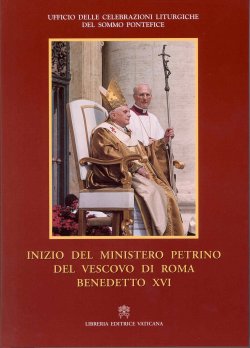
Il presente volume di commento, articolato in quattro parti: storica, teologica, rituale e celebrativa, intende offrire la possibilità di cogliere ulteriormente le rilevanti novità dell’Ordo rispetto alla precedente prassi della liturgia papale e, al contempo, la sua profonda sintonia con la riforma liturgica del Concilio Vaticano II.
I riti del nuovo Ordo, come sua Santità Benedetto XVI li ha approvati e sopratutto presieduti e celebrati, veicolano e testimoniano una visione del primato petrino conforme al dato biblico, alla tradizione dei Padri della Chiesa e alla sostanziale comprensione che di tale ministero la Chiesa da sempre ha posseduto.
In questo modo, la liturgia dell’Ordo Rituum pro Ministerii Petrini Initio Romæ Episcopi può essere indicata come un legittimo luogo e un autorevole testimone capace di attestare e tramandare la visione cattolica del ministero petrino.
L’Ordo, per il particolare valore ecclesiale ed ecumenico che riveste, può essere considerato dono e stimolo non solo per gli storici, gli studiosi e tutti i fedeli, ma per le Chiese di Occidente e di Oriente.
In realtà i Riti dell’Inizio del Ministero Petrino, che i mezzi della comunicazione sociale hanno trasmesso in tutto il mondo nei giorni della Pasqua 2005, hanno voluto celebrare il del Cristo buon Pastore, che attraverso il ministero petrino affidato all’umile pescatore di Galilea e ai suoi successori, come Capo Collegio episcopale a guidare, insieme con i Vescovi membri del medesimo Corpo episcopale, il suo gregge verso il Regno nel cammino della storia. Presenza e ministero che hanno nella celebrazione liturgica la loro fonte e la loro attualità.
I riti dell’inizio del Pontificato, celebrati nello spirito della liturgia del Concilio Vaticano II, rimangono un segno e una speranza per il cammino della Chiesa nel mondo.
La lex orandi espressa dall’Ordo Rituum pro Ministerii Petrini Initio Romæ Episcopi possa essere luogo di incontro e punto di partenza per in rinnovato dialogo tra Chiese sorelle, nella ricerca della comunione visibile e nel riconoscimento di quel ministero posto dal Signore a servizio di tale comunione.
---
Inizio del Ministero Petrino del Vescovo di Roma Benedetto XVI, Libreria Editrice Vaticana 2006, ss. 566.
June 24, 2010
Ks. Jerzy Stefański - Stolica Apostolska 'Sede Vacante'. Wybór Benedykta XVI
Dzięki uprzejmości ks. Jerzego Stefańskiego, publikujemy kolejny artykuł jego autorstwa. Tym razem autor omawia w nim czas, gdy Stolica Apostolska była w stanie wakatu po śmierci Sługi Bożego Czcigodnego Jana Pawła II, a także obrzędy wyboru jego następcy Ojca Świętego Benedykta XVI. Artykuł ten został pierwotnie opublikowany w książce: Odnowa liturgii trwa, Włocławek 2008 (s. 27-39).
Czas upływający od chwili zgonu papieża do dnia wyboru jego następcy określany jest tradycyjną, „techniczną” formułą jako Sede Vacante (odtąd = SV). Okres ten wypełniony jest szeregiem inicjatyw ustalonych przez prawodawstwo kościelne, które normuje dalsze, zwyczajne funkcjonowanie i zarządzanie Kościołem i zarazem zmierza do uporządkowanego przygotowania wyboru nowego papieża. Aktualnie obowiązujące są w tej materii postanowienia Jana Pawła II zawarte w Konstytucji Apostolskiej z dnia 22 lutego 1996 Universi Domnici gregis[1].
W naszej rozprawie[2] chcemy przybliżyć najważniejsze z tych wydarzeń wypełniających okres SV, kładąc punkt ciężkości na obrzędowych inicjatywach związanych z przygotowaniem i przebiegiem Conclave, które w dniu 19 kwietnia 2005 wybrało papieżem Benedykta XVI.
[1] Zob. Johannes Paulus II, Constitutio Apostolica Universi Dominici Gregis, De Sede Apostolica vacante deque Romani Pontificis electione, 22 februarii 1996, w: AAS 88(1996)305-343 (odtąd = UDG).
Warto tutaj za powyższym dokumentem przypomnieć, że prawie wszyscy papieże XX wieku opublikowali relatywne rozporządzenia regulujące zasady wyboru nowego papieża, zob. np. Paulus VI, Constitutio Apostolica Romano Pontifici eligendo, 1 X 1975, w: AAS 67(1975)609‑645; Johannes XXIII, Motu proprio Summi Pontificis electio, 5 IX 1962, w: AAS 54(1962)632-640; Pius XII, Constitutio Apostolica Vacantis Apostolicae Sedis, 8 XII 1945, w: AAS 38(1946)65-99, itd.
[2] Niniejsze opracowanie jest częścią swoistego „tryptyku” artykułów na temat prawodawstwa, liturgii i zwyczajów związanych ze śmiercią i pogrzebem papieża, okresem Sede Vacante, Conclave oraz początkiem posługi nowego papieża. Część pierwszą związaną z obrzędami pogrzebowymi odnoszącymi się do osoby papieża, w oparciu o Ordo Exsequiarum Romani Pontificis z roku 2000 zob. J. Stefański, Liturgia pogrzebu papieża. W rocznicę śmierci Jana Pawła II (1978-2005), w: M. Olczyk, P. Podeszwa (red.), Evangelizare pauperibus, Gniezno 2007, ss.475-491. Część trzecia „tryptyku” omawia obrzędy liturgiczne związane z początkiem nowego pontyfikatu w oparciu o księgę Ordo rituum pro ministerii petrini initio Romani Episcopi, E Civitate Vaticana 2005, pp. 228. Ukaże się ona w Studia Gnesnensia.
---
June 9, 2010
May 30, 2010
The Papal Ombrellino - Benedict XVI

May 17, 2010
May 2, 2010
'Habemus papam!' - Election of the Popes in history [videos]
From 'Catholic Encyclopedia': 'The supreme headship of the Church is, we have seen, annexed to the office of Roman bishop. The pope becomes chief pastor because he is Bishop of Rome: he does not become Bishop of Rome because he has been chosen to be head of the universal Church. Thus, an election to the papacy is, properly speaking, primarily an election to the local bishopric. The right to elect their bishop has ever belonged to the members of the Roman Church. They possess the prerogative of giving to the universal Church her chief pastor; they do not receive their bishop in virtue of his election by the universal Church' (see more: here and here)