
October 14, 2014
August 14, 2014
Venanzio Filippo Piersanti da Matelica (znany jako Piersanctes)... czyli ceremoniarza papieskiego skarby

W jednej z włoskich miejscowości, której nazwa przynosi na myśl jeden z najsłynniejszych metalowych zespołów muzycznych, znajduje się muzeum zawierające kolekcję wywodzącego się z tamtych stron osiemnastowiecznego ceremoniarza papieskiego.
Mowa o Venanzio Filippo Piersantim (1688-1761.) z Mateliki. W wieku trzydziestu lat (dokładnie 30 marca 1718 r.) został on powołany do służby w kolegium papieskich ceremoniarzy jako szósty z mistrzów ceremonii (tak więc jako pierwszy z teoretycznie siedmiu supranumerarii).
Jako, że uwielbiał on gromadzić różne ciekawe i związane z katolicyzmem, kulturą i sztuką przedmioty, dzięki niemu powstało może nie ogromne, ale zasobne w eksponaty Museo Piersanti w Matelice we Włoszech (tutaj kilka słów historii: czytaj).
 |
| Portret Piersantiego w muzeum w Matelice. (zdjęcie: Caeremoniale Romanum) |
Szczegóły dotyczące muzeum oraz kilka zdjęć sal ze zgromadzonymi eksponatami można znaleźć w sieci internetowej. Tutaj chcemy opublikować tylko kilka zdjęć przedstawiających bądź to przedmioty związane z liturgią papieską (a więc urzędem pełnionym przez lata przez Piersantiego).
Niestety, nie spisaliśmy oryginalnych opisów przedstawianych tutaj eksponatów, ale to - jak mamy nadzieję - zachęci ewentualnych podróżników po włoskich ziemiach, by odwiedzić dziesięciotysięczne miasto jakim jest Matelica (tym bardziej, że kler ma tzw. "darmowe wejściówki").
 |
| Statystyki dotyczące udzielania sakramentów w czasie kaplic papieskich za rok 1726. Obok jednego z arcybiskupów, również sam Papież Benedykt XIII chrzcił, bierzmował, wyświęcał... . Jest to tylko jedna z wielu stron słynnych dzienników redagowanych przez papieskich mistrzów ceremonii. Jak się okazuje nie wszystkie znajdują się w archiwum dzisiejszego Urzędu Papieskich Celebracji Liturgicznych... . (zdjęcie: Caeremoniale Romanum) |
 |
| To również bardzo ciekawy dokument, mianowicie... swego rodzaju lista obecności kardynałów na konklawe. Jak widać ta cenna pamiątka została oprawiona przez samego Piersantiego. (zdjęcie: Caeremoniale Romanum) |
 |
| To jedna z baryłek wina jakie wręczało się Papieżowi w czasie kanonizacji (najczęściej przez postulatorów lub osoby związane ze świętym) bądź konsekracji biskupich (przez elektów). Biskupi Rzymu mieli w zwyczaju obdarowywać podobnymi pamiątkami osoby ze swego otoczenia, i to z różnych względów (za zasługi, z sympatii, czy też, aby wreszcie mieć święty spokój... co potwierdza już diarium słynnego Jana Burkcharda). Szczegółów o baryłkach i nie tylko można się dowiedzieć tutaj: czytaj; opis kanonizacji obrazujący całościowo dawne, piękne i niezwykle bogate w symbolikę ceremonie można przeczytać w tym miejscu; co do konsekracji biskupich... cierpliwości, drodzy Czytelnicy, cierpliwości, bo zostanie ona nagrodzona! (zdjęcie: Caeremoniale Romanum) |
 |
| Na zdjęciu powyżej znajduje się "papieski niezbędnich na Jubileuszowy Rok Święty", szczegóły i materiały można zobaczyć: tutaj. (zdjęcie: Caeremoniale Romanum) |
 |
| Na deser część kolekcji Piersantiego: kielichy, puszka, łódka oraz relikwiarz, bodajże z agnuskiem. (zdjęcie: Caeremoniale Romanum) |
August 10, 2014


June 30, 2014
Zasoby British Pathé
Dla informacji Czytelników i Sympatyków portalu:
Od pewnego już czasu brytyjska British Pathé udostępniła swe zasoby na YouTube, co ułatwiło dostęp do wielu brytyjskich (wspaniałe liturgie w katedrze Westminster, np. tu, tu lub też tutaj [ceremonie dworu brytyjskiego]) lub papieskich klipów "liturgicznych". Tych ostatnich jest ponad setka, należy je wyszukiwać wg słów kluczowych takich jak "conclave", "cardinal", "pope", "coronation" (później reszta będzie się wyświetlać w podpowiedziach).
Przykładowy film:
Ten zabieg agencji filmowej en question pozwala na o wiele łatwiejszy zapis zgromadzonych materiałów filmowych na dysk twardy (np. za pomocą wtyczek do używanej przeglądarki internetowej).
April 15, 2014
De creatione novorum cardinalium
Nadawanie godności kardynalskiej jest wyłącznym przywilejem Ojca Świętego, który w dowolnym czasie mógł dobrać nowych purpuratów do, ustalonej na siedemdziesiąt, liczby członków Kolegium. W sposób formalny zaczynało się to od poinformowania w czasie sekretnego konsystorza obecnych kardynałów o chęci powołania nowych. Papież zwracał się do obecnych z zapytaniem: Quid vobis videtur? Był to zwrot czysto kurtuazyjny, wywodzący się jeszcze z czasów, gdy wybór nowych kardynałów musiał spotkać się z akceptacją większości dotychczasowych książąt Kościoła. Za odpowiedź starczał jedynie gest purpuratów, którzy powstawszy ściągali piuski i pochylali głowy. Wtedy papież oficjalnie ogłaszał swoją decyzję następującymi słowami: Auctoritate omnipotentis Dei, sanctorum apostolorum Petri et Pauli ac Nostra, creamus Sanctae Romanae Ecclesiae Cardinales presbyteros quidem N.N. diaconos vero N.N., cum dispensationibus, derogationibus et clausulis necessariis et opportunis. In nomine Pa+tris et Fi+lii et Spiritus + Sancti. Amen. Papież mógł też dokonać wyboru kardynałów, których imiona, z różnych powodów, zachował jedynie dla siebie. Ogłaszał to Konsystorzowi w sposób następujący: Alios autem [tu podawał liczbę wybranych] in pectore reservamus arbitrio Nostro quandocumque declarandos.
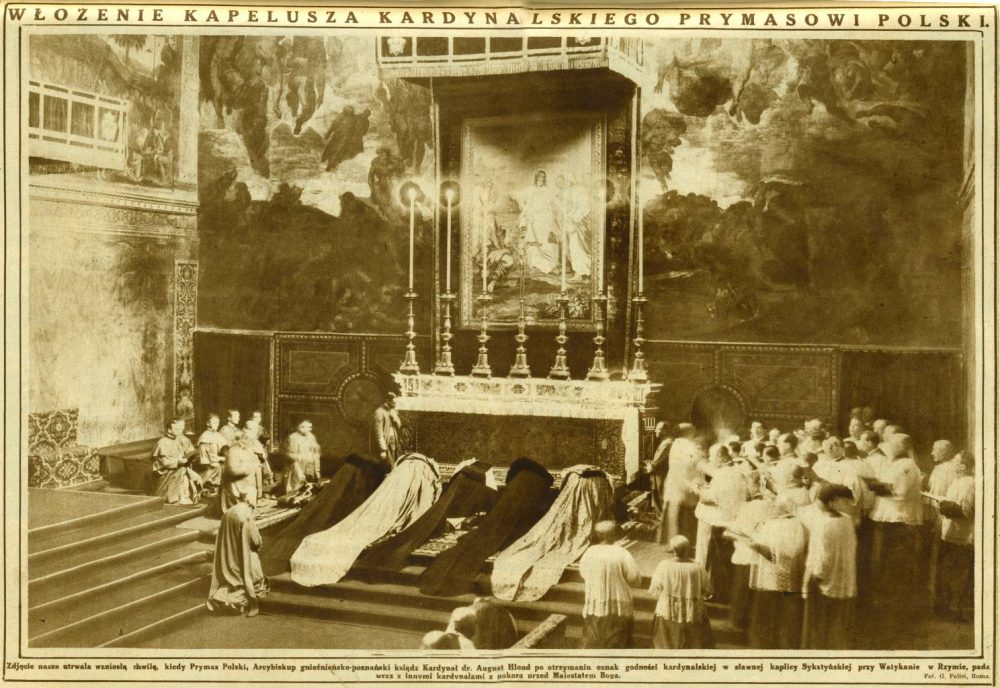
Appointing new cardinals is the exclusive privilege of the Holy Father who, in any time, could nominate new prelates, not exceeding the fixed number (seventy) of the College members. In the formal way the procedure started from informing the cardinals, present on a secret consistory, about the Pope’s will to create the new ones. The Pope addressed the present: Quid vobis videtur? It was a purely courteous expression, dating back to the times when the election of the new cardinals had to be accepted by the majority of the then princes of the Church. As a response sufficed only the gesture of the prelates who, having risen to their feet, took off their zucchettos and bowed their heads. Then, the Pope announced officialy his decision with the following words:Auctoritate omnipotentis Dei, sanctorum apostolorum Petri et Pauli ac Nostra, creamus Sanctae Romanae Ecclesiae Cardinales presbyteros quidem N.N. diaconos vero N.N., cum dispensationibus, derogationibus et clausulis necessariis et opportunis. In nomine Pa+tris et Fi+lii et Spiritus + Sancti. Amen. The Pope could also choose cardinals whose names, because of various reasons, he kept only for himself. He announced it to the consistory in the following way: Alios autem [here the number of the elected was given] in pectore reservamus arbitrio Nostro quandocumque declarandos.
March 6, 2014
De Benedictione Ensis et Pilei
Błogosławieństwo miecza oraz kapelusza (wł. stocco e berrettone) dokonywało się w sposób uroczysty przed Matutinum w noc Bożego Narodzenia, ale także czasem po Mszy Świętej w nocy lub przenoszono je na poranek 25 grudnia. Poświęcone przez papieża przedmioty były wręczane katolickim władcom oraz dowódcom, którzy w walce z niewiernymi czy heretykami przysłużyli się obronie Kościoła i wiary. Zwyczaj ten, wywodzący się ze starszych ceremonii obdarowywania władców bronią przez papieży, trwał od 1385 r., a ostatni znany nam przykład jego zastosowania miał miejsce w roku 1825. Wśród zachowanych imion wyróżnionych monarchów poczesne miejsce zajmują królowie Polski.

The blessing of the sword and the hat (it. stocco e berettone) was conducted in a solemn way before the Matutinum on the Christmas night, but also sometimes after the Mass in the night or it was postponed to the morning of 25 December. The items blessed by the pope were given to the Catholic monarchs and commanders who contributed to the defence of the Church and the faith in the fight against infidels or heretics. This habit, having its roots in older ceremonies of presenting the rulers with weapon by popes, lasted since 1385 and the last known example of its use took place in the year 1825. Among recorded names of the honoured sovereigns a prominent place is occupied by Polish kings.
De missis papalis
Liturgia papieska miała kilka wariantów. Z zasady dzieliła się, podobnie jak msza biskupia, na czytaną i pontyfikalną.Msza codzienna odprawiana była zazwyczaj w prywatnej kaplicy w Pałacu Apostolskim lub w rezydencji w Castel Gandolfo. Papież ubrany był i odprawiał w ten sam sposób, jak każdy biskup, używał mszału i kanonów ołtarzowych, więc liturgia ta nie różniła się zbytnio od codziennej mszy każdego księdza. Jak do tej pory tylko w przypadku Piusa XII trafiliśmy na zdjęcia, na których do Mszy służył mu jedynie jego kamerdyner w żakiecie, a nie któryś z papieskich familiares.
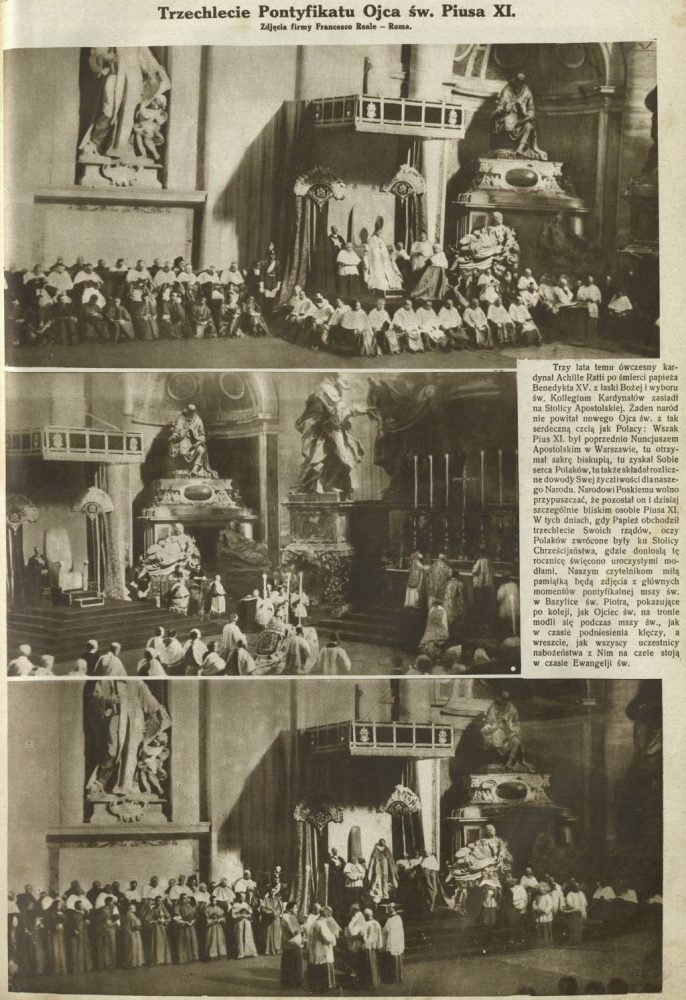
The papal liturgy had several variants. As a rule it was divided into a Low Mass and into a Pontifical Mass, similarly to the bishop’s Mass. An everyday Mass was usually celebrated in a private chapel in the Apostolic Palace or in the residence in Castel Gandolfo. The Pope was dressed and celebrated the Mass in the same manner as every bishop did; he used the missal and the altar cards, so this liturgy did not differ much from an everyday mass of any priest. Until now, only in the case of Pius XII we have encountered photos on which one may observe that it was only the butler in a tail-coat and none of the papal familiares who served the Pope during the Mass.
De Conclavi seu de electione Romani Pontificis
We Mszy o Duchu Świętym, celebrowanej przed rozpoczęciem konklawe, kardynałowie uczestniczyli ubrani w cappa magna. Po jej zakończeniu, z pulpitu pokrytego czerwonym adamaszkiem, stojącego po stronie Ewangelii, odczytywano De eligendo Pontifice – modlitwę przypominającą kardynałom o znaczeniu ciążącego na nich obowiązku wyboru nowego papieża.

Cardinals dressed in a cappa magna participated in the Mass of the Holy Spirit, celebrated before the beginning of the conclave. After the mass, from a special stand, covered with red damask, set on the Gospel side, De eligendo Pontifice was read; it was the prayer which reminded cardinals of the relevance of the duty resting on them – to elect a new pope.
February 24, 2014
I.-H. Dalmais - Van Dijk, The ordinal of the papal court from Innocent III to Boniface VIII and related documents
VAN DIJK, Stephen J. P. The
ordinal of the papal court from Innocent III to Boniface VIII and related
documents. Completed by Joan Hazalden Walker. Fribourg Sw: The university
Press (coll. « SpicilegiumFriburgense », 22), 1975. LXIII – 712 p.
Voici enfin
rassemblés et soigneusement édités un ensemble de textes qui éclairent un
moment décisif de l’histoire de la liturgie romaine. Les travaux antérieurs du
P. Van Dijk sur Haymo de Faversham et la codification de la liturgie
franciscaine entre 1243 et 1307 (Leyde 1963) avaient mis en pleine lumière à la
fois le rôle primordial joué par les Franciscains dans la diffusion d’une
liturgie qui sera à la base des codifications post-tridentines et la source à
laquelle avait puisé cette liturgie franciscaine : les livres et
ordinations liturgiques élaborés durant le 13e siècle, à partir
d’Innocent III pour l’usage de la Curie et de la Chapelle papale. Mais ce grand
travailleur n’avait pas eu le temps de mener à son entier achèvement l’édition
projetée des recensions successives de l’Ordinal et des Calendriers à l’usage
de la Cour papale. Le Dr J. Hazellden Walker, liturgiste anglais qui avait été
son collaborateur depuis 1954, s’est employé après la mort du P. Van Dijk (8
mars 1971) à mener à son terme l’entreprise considérable et difficile de cette
édition.
Pour les
Calendriers, elle présente successivement : le calendrier de la Cour
papale entre 1175 et 1202 d’après la tradition des sacramentaires représentée
par un Sacramentaire papal (Madrid B. N. lat. 730) et le Bréviaire de saint
François conservé à Assise ; le calendrier des Frères mineurs établi entre
1227 et 1230 et dérivant des livres d’Honorius III (1216-1227) ; enfin
celui de la tradition « néo-urbaine » créée, probablement vers le
milieu du 13e siècle par le cardinal Jean Gaétan Orsini, le futur
Nicolas III (1277-1280), en combinant l’ancien rite urbain de Saint-Pierre au
Vatican avec le nouveau rite de la Curie papale.
Pour
l’ordinal d’Innocent III, compilé entre 1213 et 1216, on dispose d’une copie (Paris,
B. N. lat. 4162 A) exécutée en 1365 pour le cardinal Egidio Albornoz, légat
papal pour l’Italie ; mais diverses sources secondaires permettent d’en
vérifier l’exactitude, le cas échéant de la compléter et d’en corriger les
nombreuses erreurs et interpolations. Cette édition, qui occupe la plus grande
partie du volume, est suivie de celles des rubriques générales du Missel avant
1228-1230 de l’Ordo Missae selon
l’usage de la Cour romaine antérieurement à 1227 et de l’Ordinal de Grégoire X
(c. 1274).
Les
introductions, rédigées pour la plus grande part par le P. Van Dijk, les Indices des manuscrits, de l’incipit de toutes les pièces
mentionnées, des références bibliques et patristiques, des Stations, des Fêtes,
enfin un index des noms et des sujets, œuvres du Dr. J. Hazelden Walker,
achèvent de faire de cet ouvrage monumental un instrument de travail de toute
première importance, non seulement pour les liturgistes et les médiévistes,
mais pour quiconque s’intéresse aux institutions et à la vie de l’Eglise
romaine.
Irénée-Henri
DALMAIS o. p.
La Maison-Dieu, 134, p.
127-128.
February 20, 2014
Monseigneur Michel Andrieu (1886-1956)
La
signature de Mgr Andrieu n’est jamais parue dans La Maison-Dieu et pourtant chacun de nous a ressenti vivement la
perte immense que faisait la pastorale liturgique, quand nous avons reçu la
nouvelle de sa mort, le 1er octobre, alors que nous découpions avec
joie les pages du IVe tome des Ordines
Romani, tout juste sorti des presses.
Si la pastorale liturgique doit
maintenir le contact avec tous ceux qui ont charge pastorale, elle doit
s’appuyer aussi sur l’histoire des institutions liturgiques ; elle ne
saurait progresses sans une perpétuelle référence aux savants. Or Mgr Michel
Andrieu était sans contredit la plus haute autorité scientifique dans le
domaine liturgique. Le disciple de Duchesne avait égalé son maître, il laissera
une marque aussi profonde dans l’histoire de la liturgie. L’un et l’autre
savaient allier à l’exigence scientifique la plus rigoureuse l’art de l’exposé
limpide dans une langue vivante et une syntaxe sans bavure ; l’un et
l’autre communiaient dans l’amour de la Rome chrétienne du haut moyen âge, où
clercs et moines francs étaient venu apprendre à célébrer, dans une liturgie à
la fois sobre et majestueuse, les mystères du Seigneur. Il n’est pas jusqu’à
une certaine tournure d’esprit, où la causticité savait s’allier au respect du
sacré, qui n’établissait une parenté entre le Rouergat de Millau et le Breton
de Saint-Servan.
Louis Duchesne est mort en 1922.
C’est en 1924 que le nom de Michel Andrieu s’imposa à l’attention par la
publication de son étude sur la consécration par contact dans les documents
liturgiques du moyen âge, Immixtio et
consecratio, qui jetait un jour si nouveau sur l’usage de la communion sous
les deux espèces et le rite de la commixion des sancta à la messe. Désormais,
le nom de M. Andrieu n’apparaîtrait plus dans une revue sans apporter la même
lumière sur l’un ou l’autre des problèmes de l’histoire de la liturgie, du
classement des sacramentaires romains au Missel de la Chapelle papale, à
l’histoire des Ordres mineurs dans l’ancien rite romain et à la genèse du
cardinalat.
Mais la grande œuvre d’Andrieu a
consisté dans la publication des Ordines
romani du haut moyen âge (4 volumes parus de 1931 à 1956) et du Pontifical romain au moyen âge (4
volumes, 1938-1942). Le but de l’auteur était sans doute de publier une édition
critique des textes, de reprendre, avec toutes les possibilités que nous offre
la science contemporaine, les travaux de Mabillon et de Martène, mais aussi
d’établir entre les textes une filiation, de les dater et de les
localiser : l’origine franque des Ordines
romani, l’influence déterminante de Durand de Mende dans le passage du
Pontifical de la Curie au Pontifical romain du XVIe siècle,
l’identification de l’origine mayençaise et l’importance hors de pair du
Pontifical publié par Hittorp, autant de résultats définitivement acquis à
l’histoire de la liturgie.
Le secret des plus grands est de
pouvoir faire ressortir d’une étude de détail les principes généraux qui
éclairent tout un domaine du savoir et ouvrent un champ nouveau à la recherche.
C’est jusqu’à ce plan qu’il faut situer l’influence de Mgr Andrieu : on
n’écrira plus l’histoire de la liturgie romaine après lui comme on l’a écrite
avant lui. L’amalgame des rites romains et des rites francs dans l’Empire
carolingien, l’élaboration d’une liturgie romano-germanique qui descend en
Italie par le Brenner avec les empereurs saliens au Xe siècle, son
implantation dans la Cité apostolique, ne constituent pas seulement l’histoire
du pontifical romain, mais aussi celle du missel, du sanctoral, de l’office.
Tous les travaux qui seront menés sur les structures de la liturgie romaine du
VIIIe au XIIIe siècle demeureront longtemps tributaires
d’Andrieu.
Mgr Andrieu nous quitte en pleine
maturité : son œuvre essentielle est achevée, au moins en manuscrit, mais
nous le savions rempli de projets qu’il espérait mener à bien dans la retraite
studieuse, où il n’a pas eu le loisir de s’installer, puisqu’il n’a abandonné
sa charge de Doyen de Faculté catholique de Théologie du Strasbourg qu’en
juillet dernier. Saint-Louis des Français, la Bibliothèque vaticane, la Rome de
sa jeunesse sacerdotale attendaient avec affection sa visite. Le Seigneur ne
l’a pas permis.
Pour nous, qu’il nous suffise de
faire monter vers Dieu la prière que nous ne lirons plus désormais sans émotion
à la dernière page du dernier volume paru des Ordines romani : « Animam
de corpore quam assumpsisti, Domine, fac gaudere cum sanctis tuis in gloria[1]. »
Pierre
Jounel
[1] Michel Andrieu, Les Ordines romani du haut moyen âge, tome IV, Louvain, 1956 : Ordo XLIX, Ordo qualiter agatur in obsequium defunctorum, p. 529.
January 24, 2014
Bibliographie - J. Nabuco, Ius pontificalium

Mgr
Nabuco, bien connu pour sa Pontificalis
Romani expositio juridico practica
en trois volumes, avait l’intention de faire également un
commentaire du Caeremoniale
episcoporum.
Deux motifs l’ont détourné de ce projet : d’abord le fait
que Mgr Gromier préparait de son côté un ouvrage de ce genre, - je
le déplore d’autant plus vivement que le livre de Mgr Gromier,
dont on trouvera ailleurs une recension, est loin d’être le
commentaire que l’on attendait en ne fera qu’apporter un peu plus
de confusion dans les esprits. – Le second motif qui a dissuadé
Mgr Nabuco est plus important : la réforme de la semaine sainte
inaugure un nouvel esprit et suggère une révision du Caeremoniale.
C’est pourquoi l’auteur a préféré publier un travail plus
général qui, tel quel, n’existait pas encore : une synthèse
de la législation sur les pontificaux. En effet, le Caeremoniale
a été modifié sur bien des points et, alors qu’il n’envisageait
que les célébrations accomplis par l’évêque et ses supérieurs,
le Saint-Siège a concédé le droit à certains pontificaux à
diverses catégories de prélats inférieurs : la liste des
principaux documents est donnée p. XXIII. Certes, on trouvait déjà
dans divers livres ou articles des solutions aux divers cas qui se
présentent et que les organisateurs de cérémonie doivent
résoudre : ces solutions ne sont pas toujours concordantes, et
sont affirmées plus que prouvées. L’avantage du livre de Mgr
Nabuco est d’apporter chaque fois les références et arguments.
Bien sûr, il est destiné à un public international, ce qui
explique de nombreux détails qui nous sembleraient oiseux : que
de privilèges et exceptions il serait souhaitable de voir abolis !
En les exposant méthodiquement, Mgr Nabuco ne laisse pourtant pas
son horizon se borner à l’état présent des choses. Les
historiens lui sauront gré des nombreuses références qu’il leur
fournit sur bien des sujets, en particulier le catalogue des éditions
du Caeremoniale.
Les maîtres de cérémonie y puiseront pour les cas difficiles des
solutions plus sûres qu’ailleurs. J’aurais souhaité ici ou là
une présentation plus souple du caractère impératif de certaines
descriptions ou prescriptions, par exemple pour ce qui concerne
l’ornementation de l’autel (pp. 262-270) : il est facile de
constater que nulle par, heureusement, on ne s’est senti lié à la
lettre, par exemple pour les dimensions des crédences, la hauteur
des chandeliers, ou le nombre des marches. Mais ce sont là, encore
une fois, des détails. En étudiant ce livre et en l’utilisant, on
prendra une conscience plus vive du rôle de l’évêque dans la
prière de l’Église.
A.-G.
M.
---
La
Maison-Dieu,
62, pp. 151-152.
Mgr Charles Respighi

Mgr
Respighi fit, en outre, un travail sur Pierluigi de Palestrina,
demeuré encore aujourd’hui classique chez les spécialistes.
Durant cette même période il créa, avec la collaboration de
plusieurs autres, notamment le P. De Santi, l’association italienne
Sainte-Cécile dont il est demeuré jusqu’à sa mort l’infatigable
président.
Il
eut pour les catacombes, et en général tous les monuments chrétiens
de l’antiquité, une vraie passion, mélange d’érudition et de
respect, que lui avaient communiquée les leçons et l’amitié des
grands maîtres De Rossi, Stevenson, Armellini, Marucchi. Dans ce
domaine, il eut l’occasion de travailler d’une façon très
directe pendant de nombreuses années, soit comme secrétaire de la
Commission pontificale d’archéologie sacrée, organisme chargé de
conserver et rechercher les antiquités chrétiennes, soit comme
Magister
du Collegium
cultorum martyrum,
association qui a pour but de promouvoir le culte des martyrs dans
les lieux mêmes qui avaient été consacrés par la sépulture des
premiers héros de la foi. Durant ce temps que Mgr Respighi fut à la
tête de la Commission, des travaux de grande importance furent
accomplis, comme la découverte des cimetières de Pamphile et des
Giordani, les fouilles de la basilique du Latran, celles de
Saint-Pierre.
L’activité
de la plume de Mgr Respighi au service de la pastorale liturgique,
interrompue en 1914 par la mort de la Rassegna
gregoriana,
se reporta ces dernières années sur le Bollettino
Ceciliano.
C’était un retour à l’idéal des premiers jours ; mais
avec l’âge, le pouvoir d’agir s’était émoussé : Mgr
Respighi vivait désormais de souvenirs, avec cette douce tristesse
qui les accompagne. Voyez, par exemple, quelle nostalgie s’exhale
de la dernière page qu’il a écrite, en mars 1944, dans le
Bollettino,
pour commenter les journées liturgiques de Vanves :
« Le
mouvement liturgique en France, justement loué, pourra sembler à
certains être une révélation. Ce n’en est pas une pourtant, ni à
nos yeux une nouveauté. Car il compte en France de nombreux
apôtres ; son histoire, déjà ancienne, est opportunément
rappelée. Il nous est doux d’apporter, nous aussi, le souvenir
d’un ami bien cher, humble et retiré, perdu dans la foule, mais
très instruit, remarquable grégorianiste, l’abbé Henri
Villetard, qui, dans les paroisses où il accomplit son ministère
sacerdotal, réalisa pratiquement ce qu’il promouvait sur le plan
scientifique. Un soir délicieux, il y a de longues années, je lui
fis une visite inopinée, et je trouvai ses paroissiens réunis,
comme ils le faisaient chaque soir, pour terminer à l’église leur
journée de travail par la prière, le chant des Complies. Mon cher
ami tint à ce que je le présidasse ; ce fut pour moi une
grande consolation, dont je conserve le plus doux souvenir, de m’unir
au chant de la prière liturgique qui s’élevait parfaite do cœur
et de l’intime dévotion des bons et des fidèles paroissiens… Le
C. P. L. peut s’inspirer de nobles et efficaces précédents. »
Ces
lignes révèlent un homme qui a vécu son poque pleinement. A
l’entendre l’évoquer, après un demi-siècle, avec une si
profonde conviction, on ne peut même pas douter que ses paroles
cachent une nuance de naïveté.
A.
Bugnini
N.
B.
– M. Martimort, présent à Rome au moment de la mort de Mgr
Respighi, a tenu à représenter le C. P. K. à ses obsèques, qui
ont été célébrées à l’église Saint-Ignace le dimanche 8
juin.
---
La
Maison-Dieu,
12, pp. 135-136.
January 6, 2014
The Ordinal of the Papal Court from Innocent III to Boniface VIII and Related Documents

PREFACE
BY THE LATE FATHER VAN DIJK
This volume contains a series of 13th-century Roman liturgica, discovered in the last fifty years. It forms a corpus but one which differs in character from that collected in my Sources for the Modern Roman Liturgy (Leiden 1963). The latter deal with the second adaptation of the liturgy of the papal court made, after 1242, by and for members of a large organization, the Order of Friars Minor. Each represents a compilation work which, however vaguely, can be dated and assigned to a single author, even when remaining anonymous. Once approved, the document was made obligatory for the entire Order, unless, in explicitly defined details, the authority of general or provincial chapters decreed otherwise. These presented here date from the first half of the century and are, directly or indirectly, the source material of those Franciscan activities. Compiled by papal liturgists for the use of a narrow and closely knit community: the pope, his commensal chaplains and court officials - in fact for the centre of all spiritual authority - the represent a living tradition rather than a once established and accepted code of liturgical legislation. The persistent study of these documents by succesive generations of court liturgists, each working on his own manuscript(s), has made it almost impossible to unravel the skein of sources, compilations, additions, re-arrangements, etc. Thus, in most cases, they cannot be dated with accuracy nor assigned to a single specific author.
In order to establish an intelligible text and some form of chronology in the process of evolution a great variety of traditions had to be collated. And the complexity of the material presented could not be avoided. Nor should the edition offered here be regarder as definitive. On the contrary, the editor hopes that it will inspire much painstaking research of detail. Hence even an introduction, similar to that precedint The Sources would have overburdened this publication of texts. The introductory notes are kept as short as possible in the hope that an extensive study may be issued at a later date.
As the preparation of these texts was initiated in the 1940s, manu have contributed in various ways to what goes under mu name: confrères and friends, superiors of religious houses and librarians ...
*************
STEPHEN J. P. VAN DIJK, O. F. M.
The London Times, March 23rd 1971
The publication of The Ordinal of the Papal Court from Innocent III to Boniface VIII and Related Documents, volume 22 of the series Texts Concerning the History of Christian Life, in Spicilegium Friburgense, is the most fitting memorial to the late Father Stephen van Dijk who died on March 8, 1971 at Swinton Dene, Berwickshire, Scotland. This work hinges upon a life-time of devoted study and scholarship which began during the war years he spent in Italy. My discovery of papers and a diary relating to his selfless activities and subsequent imprisonment not only for his part in but also for his devotion to those, both young and old, caught up with the horrors of war, make it the more remarkable that he continued tirelessly even at this stahe to transcribe the host of manuscripts which have made this edition possible.
Fr van Dijk dod not live to complete his work. He wrote of Haymo of Faversham, <... [he] was actually working on a ceremonial when death overtook him. The draft of this ceremonial... was still on his table, when in the summer of 1244 ... the friars of Anagni carried him to his last resting place ...>. By the side of Fr van Dijk's bed lay the proofs he was correcting during his last days; on his desk in London, only some thirty-five typescripts pages of the introduction and a few notes were left.
I have collaborated with Stephen van Dijk since 1954, yet our joint publications in no way give me confidence to complete what was his work alone. I have left untouched those thirty-five pages, filling in the blanks in the footnotes, I hope with accuracy, but I take full responsibility for all possible errors. I have tried to complete the introductory notes form the brief headings and schemes I discovered, and from our various joint publications. I hope that time will bring forward a student of medieval liturgy who will take up this word and find a veritable gold mine in the vast collection of material left in my care. Stephen van Dijk called forth many tributes, perhaps the finest was that he stood out as . Yer he was a scholar of little personal ambition, humble and self-critical to the extreme. Those who worked and studied with him know that his greatest joy was that others shared his discoveries. It is with this knowledge that I offer his work to anyone who may care to take it up.
Fr van Dijk intended to name many who helped in the preparation of this edition. I cannot hope to fill in those ...! However, I am certain he would wish, first of all, that I thanked the Rt Rev Bishop of Basle, Anton Hänggi and Fr G. G. Meersseman, O. P., for their warm invitation to publish this work in this series. I am grateful to the University press of Fribourg for their patience in waiting for me to complete this work. The confrères and friends, superiors and librarians, I cannot ennumerate. I hope that all who have played their part in the initial stages of this publication will forgive my ignorance and accept my appreciation.
For my own part, I wish to express my heartleft thanks to Fr M. Dykmans, S. J. of the Pontifical University, Rome. To him I owe so much encouragement and many suggestions in the correcting of the first page proofs of the Ordinal of Gregory X. I am overjoyed that he has published an introduction to this section of Fr van Dijk's texts [1]. No greater tribute to the memory of a fellow scholar could have been made than that expressed in so practical a manner.
I am indebted to Fr Evermarus Vranken, O. F. M. who worked so painstakingly on many of the indices and who has continued to show interest. I would wish to thank the Council of Management of Whitelands College of Education, University of London for granting me a sabbatical year, and the University of Edinburgh for the award of a post-doctoral Fellowship to complete this volume.
However, my greatest debt of gratitude goes do Dr James van Winden, O. F. M. of Leiden University. His presence in Scotland within a few hours of Stephen van Dijk's death and his tireless efforts to sustain me throughout the months it has taken to complete this publication, have alone made it possible,
March 8 1973
Joan Hazelden Walker
---
[1] « Le Cérémonial de Gregoire X (vers 1273) » in Gregorianum 53, 1972, 535-65.
* * *
Stephen J. P. van Dijk (+), O. F. M., M. A., D. Phil., Joan Hazelden Walker, B. D., Ph. D., The Ordinal of the Papal Court from Innocent III to Boniface VIII and Related Documents, "Spicilegium Friburgense", Texts Concerning the History of Christian Life 22, The University Press Fribourg Switzerland, 1975, p. V-VI.
* * *
CONTENTS
Preface
Contents
Bibliography
Introductory notes (preliminary)
Method of Presentation
List of abbreviations
ROMAN KALENDARS OF THE THIRTEENTH CENTURY
I. Kalendar of the papal court according to the « sacramentary » tradition c. 1175-1202
II. Kalendar of the Roman court according to the « Regula » edition of the Friars Minor derived from the books of Honorius III and in agreement with the ordinal of Innocent III 1227-30
III. Urban Kalendar revised by cardinal John Cajetan Orsini (Nicholas III) combining the traditions od St. Peter's in the Vatican and the papal palace in the Lateran c. 1255
ORDINAL OF THE COURT OF THE ROMAN CHURCH COMPILED DURING THE REIGN OF INNOCENT III 1213-16
Temporale with ordines for Christmas and St. Stephen's day, Ash Wednesday, Holy Week, Easter, Whitsuneve, the Sundays after Pentecost
General rubrics
Sanctorale wit ordines for Candlemas, Greater Litanies
Common of the saints
Offices of the Virgin and of the dead
Order of grace at meals according to the use of the Roman court before 1227
GENERAL RUBRICS OF THE MASS before 1227
ORDER OF THE MASS ACCORDING TO THE USE OF THE ROMAN CHURCH (COURT) before 1227
ORDO ROMANUS. NOTES ON THE ORDER OF THE MASS before 1238
ORDINAL OF GREGORY X c. 1274
Election and consecration of a pope
Temporale
Sanctorale
Ceremonial notes on Mass and Office in the presence of the pope
Solemn (station) Mass celebrated by the pontiff
Greater Litanies
INDICES
I. Index of manuscripts
II. Index of cues
III. Index of biblical references
IV. Index of patristic references
V. Index of stations
VI. Index of feasts
VII. General index
Subscribe to:
Posts (Atom)